1st January 2024 · Chat GPT / Wikipedia · 249 views
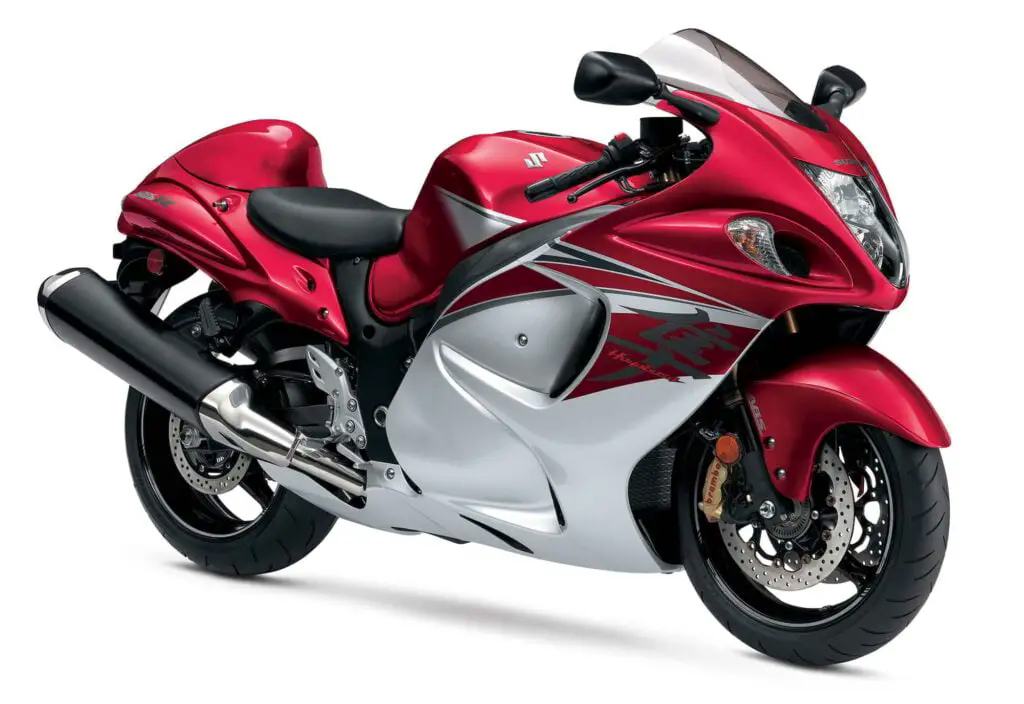
The Suzuki GSX1300R Hayabusa is an iconic ultimate sportbike powered by a 1,340cc inline-four engine that produces 190 PS (approx. 187–188 hp)
The Suzuki Hayabusa: Built to Hunt a Blackbird
If the Katana was about looking fast, the Hayabusa was about a much simpler goal: being the fastest production motorcycle on Earth, full stop.
A name with a target on its back
Suzuki launched the GSX1300R Hayabusa in 1999 with one clear mission — to dethrone Honda's CBR1100XX Super Blackbird, which had held the production-bike speed crown. The name itself was the giveaway: "Hayabusa" means peregrine falcon in Japanese, and peregrine falcons are famous for one thing above all — hunting blackbirds. Suzuki wasn't being subtle. The bike lived up to the name, too, beating the Blackbird's top speed by somewhere in the region of 16–23 km/h.
Form followed speed, not the other way round
Designer Koji Yoshiura took an approach that put aerodynamics ahead of conventional good looks. The result was that bulbous, swollen fairing that looked strange next to the sharp-edged sportbikes of the era — and drew plenty of criticism for it. But the shape wasn't an accident or a failure of styling; it was the whole point. Every curve was there to cut through air more efficiently, and it worked exactly as intended.
The speed war that ended itself
The original Hayabusa could hit speeds north of 300 km/h — reportedly 303–312 km/h depending on the bike. That kind of number, arriving right as Honda and Suzuki were trading blows in a public speed race, spooked regulators, particularly in Europe, where there was real talk of banning high-speed superbikes outright. The manufacturers' response was a "gentlemen's agreement": from the 2001 model year onward, Japanese and European brands quietly capped their production bikes at an electronically limited 299 km/h. The Hayabusa was, in effect, the bike that ended the very speed war it started.
Steady evolution, not reinvention
- First generation (1999–2007): 1,299cc inline-four, around 173 hp claimed, later reined in to that 299 km/h limit.
- Second generation (2008–2020): Bored out to 1,340cc, output up to roughly 197 hp claimed, with better suspension, brakes, and everyday comfort — while keeping the same top-speed ceiling.
- Third generation (2022–present): Still 1,340cc, around 190 hp claimed, wrapped in modern electronics and a styling refresh, now designated the GSX1300RR.
Under the skin, features like a gear-driven counterbalancer for smoothness and a ram-air intake system to force extra pressurized air into the engine helped the Hayabusa feel as refined as it was fast.
An unlikely sales success
Superbikes typically sell best in their launch year and taper off after — the Hayabusa did the opposite, with sales climbing steadily from 1999 through 2008, passing 100,000 units sold by June 2007. It also became a favourite in the tuning and customisation world thanks to how responsive the engine was to modification, and its engine found a second life well beyond motorcycles — powering kit cars like the Westfield Megabusa and Radical SR8, sandrails, and even experimental aircraft. It's also seen real-world service with police forces including Oklahoma Highway Patrol and Humberside Police in the UK.
In 2011, a turbocharged Hayabusa ridden by Bill Warner set a motorcycle land speed record of 502.027 km/h (311.945 mph) — a reminder of just how much headroom was left in that engine once the rev limiter came off.
Adapted from the Wikipedia article "Suzuki Hayabusa," used under CC BY-SA 4.0.